
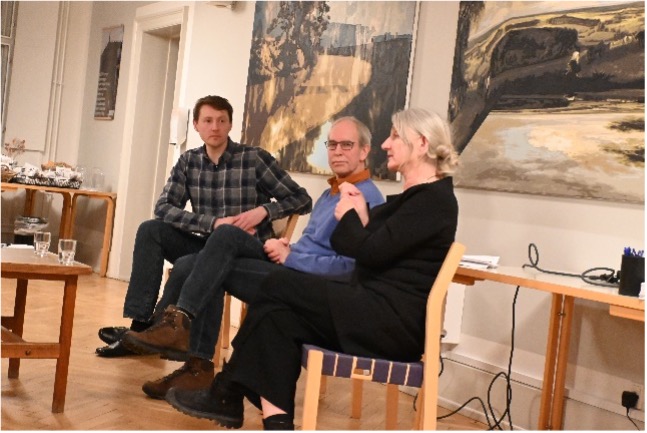
On Tuesday, January 23, 2024, iiINTERest hosted a dialogue meeting at CISU’s premises at Vartov in Copenhagen. The room, provided by CISU for the purpose, was named ‘Mathilde Fibiger’. This came with a certain obligation. Mathilde Fibiger was indeed one of the first major debaters of the Danish Women’s Movement, who stirred up public debate when she proclaimed ‘The Emancipation of Women’ in the mid-19th century. Although our vision was smaller in both impact and scope, the intention of our debate evening was largely the same: namely, to initiate a discussion on the need for poverty alleviation among the poorest population groups in India and Nepal.
The dialogue meeting was the result of a long-standing desire within iiINTERest’s board to create a forum where we could discuss and generate debate on some of the topics central to our projects and efforts in India with a broader audience of interested individuals – both members and non-members – and to initiate a professional exchange with other development organizations working on similar issues and contexts as us. Therefore, in December 2023, the board of iiINTERest sent an email to (among others) CICED – a member organization of CISU specializing in education in various global contexts, including Nepal – inviting them to collaborate. Fortunately, they responded quickly – they were very interested in meeting us!
After a few introductory and planning meetings, we agreed on the format: we would host a debate evening under the title ‘Poverty Alleviation in India and Nepal’, where we would discuss our different approaches to poverty alleviation and gain insights into our own and each other’s approaches and practices. The two representatives invited to debate were Søren Jeppesen (chairman of iiINTERest) and Rita Tissdale (board member and longstanding member of CICED). To ensure that the evening did not become a self-congratulatory event for our work, we invited journalist and expert on India, Thomas Gringer Jakobsen, to moderate the conversation.
With an opening question about whether countries like India and Nepal even need support for poverty alleviation through Danish development assistance, Thomas ignited the discussion. What followed was an exciting and thought-provoking debate that tackled some of the biggest questions and challenges of development work today: Is it even necessary to talk about poverty alleviation in 2024? Can we measure the impact of development initiatives that span decades and involve countless actors? How do we create local ownership and inclusion of project participants? What is needed to ensure the sustainable integration of our project activities? And how do we ensure fair conditions for our local partners without imposing too high or unrealistic demands? The topics were numerous and the curiosity was great. Among the audience were members of the two associations, as well as representatives from several of CISU’s other member organizations, who contributed their own experiences and asked good and relevant questions to the panelists.
Although India has experienced economic growth since the 1990s and today has sent rockets to the moon and invested in major infrastructure projects around the world, there is still a need for poverty alleviation efforts. Inequality in India is enormous, and while the political elite has been enriched over the past few decades, conditions in rural areas have either stagnated or worsened. This is particularly due to the large number of young men, in particular, who migrate to the cities and leave behind the least resourceful family members in the villages. Many of the challenges that we at iiINTERest are familiar with from an Indian context also apply to the areas in Nepal where CICED works. This allowed us to have a constructive conversation about methods and approaches to poverty alleviation work – a type of exchange that is important as organizations when navigating the difficult contexts in which we work.
All in all, the evening was a great success – and we found that we could easily have held 10 more debate evenings to delve into the many questions raised. For the same reason, we also intend to continue our collaboration with CISU and hope that other organizations will also come forward with input. We hope that the events can be the first tentative steps towards greater visibility for the poverty alleviation work taking place around the world. We also hope that through sharing experiences and engaging in critical discussion, we can develop our thoughts, purposes, and methods for creating more just conditions – economically, socially, and culturally wherever we are in the world.