
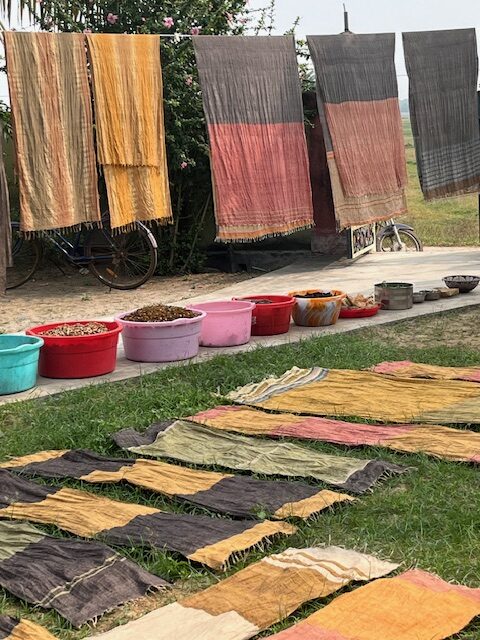
Creating development and finding a common path for communication when culture and language pose a challenge can be paved with significant obstacles. Therefore, we have utilized the shared nature that encompasses us all as a starting point for how silk can be produced and presented. The wild tussah silk we work with in the village has been a source of income for generations; it is processed by both men and women in the family. Women spin the thread, and men weave it. Subsequently, the fabric is sent to other families, where men are responsible for decorating the fabric using printing blocks and hand painting, and women embroider and sew. Traditionally, the motifs have been inspired by village life, but as middlemen have taken control of the fabrics, the village has been more subjected to orders from urban areas, causing the motifs to lose their local touch. In the craft project, we reclaim some of what was lost by focusing on nature.
This leads to discussions about what we do to protect our environment. For example, it could involve avoiding the use of chemicals, which have been the village’s way of dyeing fabrics over the past decades, leading to pollution of fields and drinking water through wastewater from production. Through numerous experiments, we have now identified a range of natural dyes extracted from plants, flowers, fruits, and leaves. Overall, all possible elements from the surrounding nature have been tested to find the colors that can bind to tussah silk. The results are: no toxins polluting their soil, drinking water, or food.
New initiatives are needed to preserve the fantastic production that has sustained families for generations but is now dwindling in the modern world unless given a helping hand. The youth cannot be retained in the village and are drawn to large cities, where a meager existence as construction or factory workers is often the result. Life for those left in the village becomes even poorer. Through many experiments, we have now succeeded in producing products that align with the surrounding nature, do not produce toxins for either soil or people, and have an expression rooted in the lives and surroundings of those involved.
With such a product in hand, there is an opportunity to engage in dialogue with potential customers about how we can all be aware and take care of our planet. It is a long journey to produce a product that is handmade in all processes and made with such simple materials and under such simple facilities, as is the case in Tantipara. Many processes occur exactly as they did a hundred years ago, but in many ways, that is what enables the men and women performing the work to integrate it into the modest life lived in India’s rural areas.
With the crafted products in their suitcase, a small group of artisans from the silk association has embarked on another exhibition, this time in Delhi, where a fair for handicrafts from all over India is held. It is with pride in their entire being that they can now stand and sell the fabrics that so many in their village have helped create. The hope is that there is an acceptable profit left after all expenses are paid. The products are often too expensive for the villagers themselves to afford, so they must be sold to wealthier Indians, giving them insight into how life can be lived in India’s impoverished rural areas.
Awareness of the forces of nature and what a wonderful gift it is to people can contribute to opening up the conversation we all must engage in: if we do not care for our planet and each individually consider what we can do to avoid pollution and exploitation that could ruin the potential for our shared future.
The craft initiative in Tantipara has led to interest at the district level (equivalent to regions) in contributing technical assistance and financial support to the area. Now, the new challenge is how, through collective efforts, we can involve even more families in the process so that income opportunities improve for the struggling population in some of India’s poorest rural areas. It is no small challenge – but just think, a small butterfly can bring food to the table for an entire community. It can make one feel a bit humble.